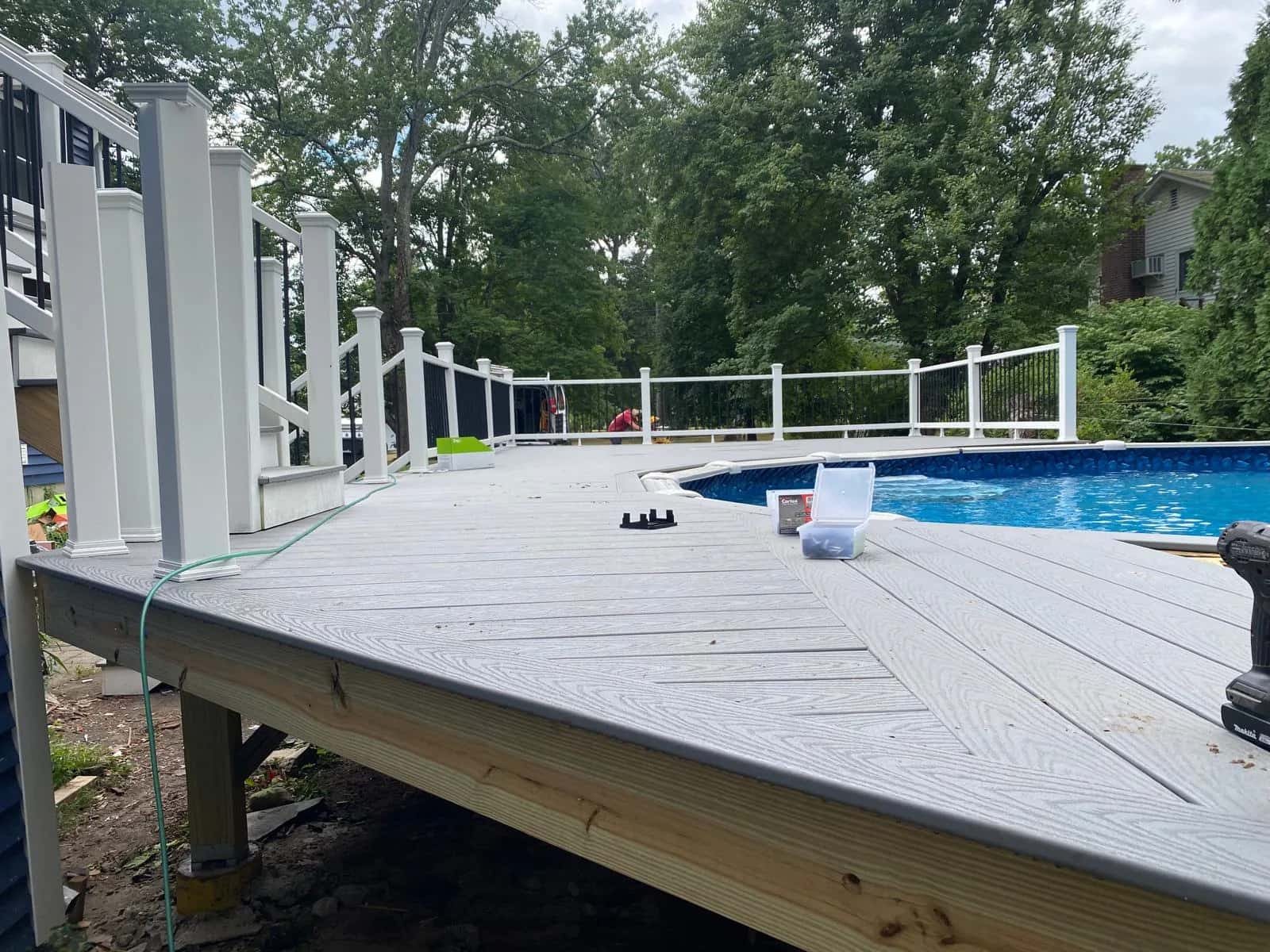
Once you have decided against wood, the decision narrows to three names very quickly. They get compared as though they were the same product at different prices, and they are not: two are wood-flour composites with a protective cap, and one contains no wood at all. In a climate that freezes and thaws dozens of times a winter, that distinction is the whole comparison.
What each costs installed
Published 2026 data puts Trex at roughly $45 to $70 per square foot installed including framing, TimberTech composite at about $40 to $70, and AZEK — TimberTech's PVC line — at roughly $60 to $80. Those figures include the substructure, which is why they look high next to a materials-only price you might see quoted elsewhere.
| Brand or line | Installed $/sq ft | Material | Published warranty |
|---|---|---|---|
| Trex | $45 – $70 | Capped wood composite | 25 yr limited, 25 yr fade and stain |
| TimberTech composite | $40 – $70 | Capped wood composite | 30 yr structural |
| AZEK (TimberTech PVC) | $60 – $80 | Solid PVC, no wood fibre | Up to 50 yr |
| Pressure-treated wood | $15 – $35 | Softwood | None in practice |
Capped composite versus PVC — the real difference
A capped composite board is wood flour and plastic with a hard polymer shell bonded to the outside. The cap is what resists fading and staining. It works well, and the large majority of composite decks in New England are exactly this.
PVC has no wood fibre in it at all. It cannot absorb moisture, which means it cannot swell, warp or feed mould from the inside. It is also lighter, and noticeably cooler underfoot in direct sun than a dark composite board.
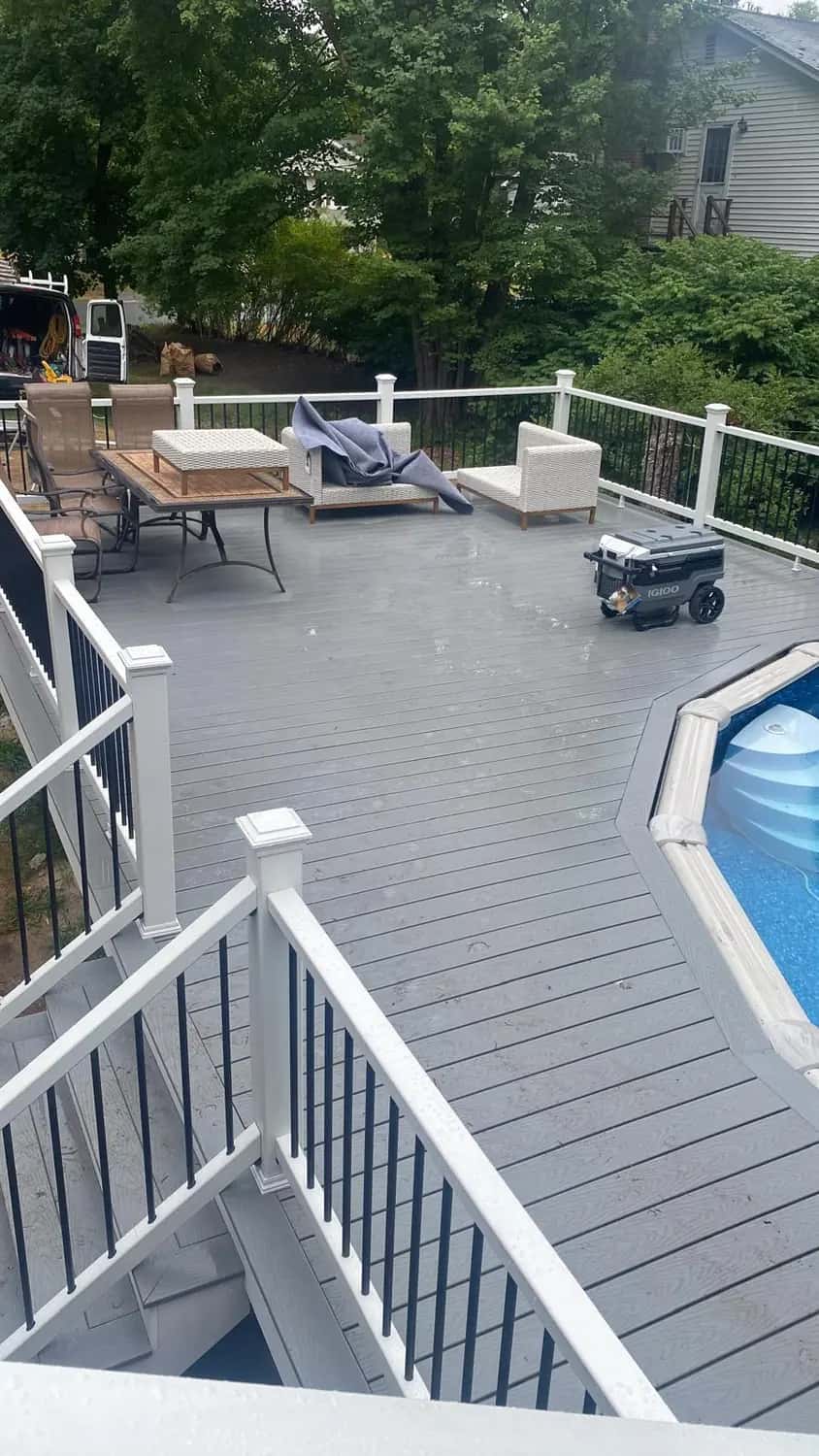
Where that matters most here is anywhere the deck stays wet: a pool surround, a low deck close to grade, a shaded north-facing deck under trees. If a cut end or a fastener hole lets water into a wood-flour core and that water freezes, you get the one failure mode composite was supposed to eliminate. PVC removes the possibility entirely.
On a normal elevated deck that dries out between rains, capped composite is a perfectly good answer and saves real money.
What the warranty actually promises
- Read what is covered. A structural warranty and a fade-and-stain warranty are separate documents with different lengths, and the headline number usually belongs to whichever one is longer.
- Almost all of them are prorated past a point. A 50-year warranty rarely pays fifty years of value in year forty.
- Installation to the manufacturer's instructions is a condition of every one of them. Wrong joist spacing or the wrong fasteners voids the coverage you paid for.
- None of them cover the frame. The pressure-treated structure under a composite surface has its own, shorter life — which is why re-decking a sound frame is excellent value and re-decking a bad one is throwing money away.
The frame is still the deck
Composite boards flex more than wood, so manufacturers commonly require tighter joist spacing — typically 16 inches on centre for a perpendicular layout and 12 inches for a diagonal one. Laying composite over a frame built at 24 inches gives you a bouncy deck and voids the warranty at the same time.
In Massachusetts and New Hampshire the footings still have to reach below the frost line, commonly four feet. No decking material compensates for a deck that heaves every winter, which is why telling whether a deck is worth repairing starts underneath rather than on the surface.
For the wood-versus-composite question rather than brand-versus-brand, see composite vs wood decking; for whole-project costs and permits, planning a new deck in Massachusetts. We build decks across MetroWest, Greater Boston and Southern New Hampshire — deck design and construction.
Where these figures come from
- HomeGuide — Best Composite Decking Brands
- HomeGuide — TimberTech Decking Cost
- HomeGuide — AZEK Decking Cost
- Angi — What Is Trex Decking
- Bob Vila — Best Composite Decking Brands
Published market data for Massachusetts and Greater Boston, not Waterfront Construction pricing. Your own project is quoted from a site visit — get a free estimate.
Frequently asked questions
What is the difference between Trex, TimberTech and AZEK?+
Trex and TimberTech composite are capped wood composites — wood flour and plastic under a polymer shell. AZEK is TimberTech's PVC line and contains no wood fibre at all, so it cannot absorb moisture, swell or warp. That matters most on pool surrounds and low, shaded decks.
Is PVC decking worth more than composite?+
Published 2026 ranges put AZEK PVC at about $60 to $80 per square foot installed against $40 to $70 for capped composite. It earns the difference anywhere the deck stays wet; on a normal elevated deck that dries between rains, capped composite performs well for less.
Does composite decking need special framing?+
Yes. Composite flexes more than wood, so manufacturers commonly require joists at 16 inches on centre, or 12 inches for a diagonal pattern. Building at 24 inches gives a bouncy deck and voids the warranty. Footings still have to reach below the frost line.
Deck Design & Construction in Northborough & MetroWest, MA →
Custom decks and outdoor living spaces in composite or wood — the perfect extension of the home you already love.
See our decks services →Want this priced for your house?
The figures above are regional market estimates. The only number that means anything is the one measured at your address — and that costs you nothing.
- ✓ Free, no-obligation estimate — itemised, not a lump sum
- ✓ Licensed & insured · MA HIC #196540
- ✓ Owner-led — you talk to the builder, not a salesperson
- ✓ We reply within one business day
Get your free estimate
Tell us about your project.