Every deck conversation ends at the same question, and it is almost always framed wrong. It is not composite versus wood — it is how long you are staying, and how many weekends you are willing to spend on maintenance.
What each costs in Massachusetts
New deck construction is commonly reported at $25 to $50 per square foot all-in. Boston-area deck projects run roughly $5,400 to $15,000, averaging near $10,200. Material alone is about $14 to $28 per square foot for pressure-treated pine, with labour a further $11 to $22.
| Material | Typical build | Upkeep | Life in New England |
|---|---|---|---|
| Pressure-treated pine | $9,000 – $16,000 | Clean & seal every 2 – 3 years | 15 – 20 years |
| Cedar | $13,000 – $22,000 | Clean & seal every 2 years | 20 – 25 years |
| Composite | $16,000 – $28,000 | Wash occasionally | 25 – 30+ years |
| PVC (fully synthetic) | $20,000 – $34,000 | Wash occasionally | 30+ years |
The break-even is later than composite salespeople say
The usual pitch is that composite pays for itself in maintenance savings. It does — but the honest crossover on a typical Massachusetts deck falls somewhere between year seven and year twelve, and only if you would genuinely have sealed the wood on schedule.
Most homeowners do not. If your realistic maintenance plan for a pressure-treated deck is 'clean it when it looks bad', then you are not comparing composite against a maintained wood deck — you are comparing it against a deck that will grey, splinter and need board replacement sooner. That changes the arithmetic in composite's favour.
How each behaves through a New England year
- Pressure-treated — moves a lot with moisture. Boards cup and check, fasteners work loose, and the surface greys within two seasons unless sealed. It handles snow load and shovelling fine.
- Cedar — is more stable and far better looking, but softer — it marks more easily, and the colour still needs sealing to hold.
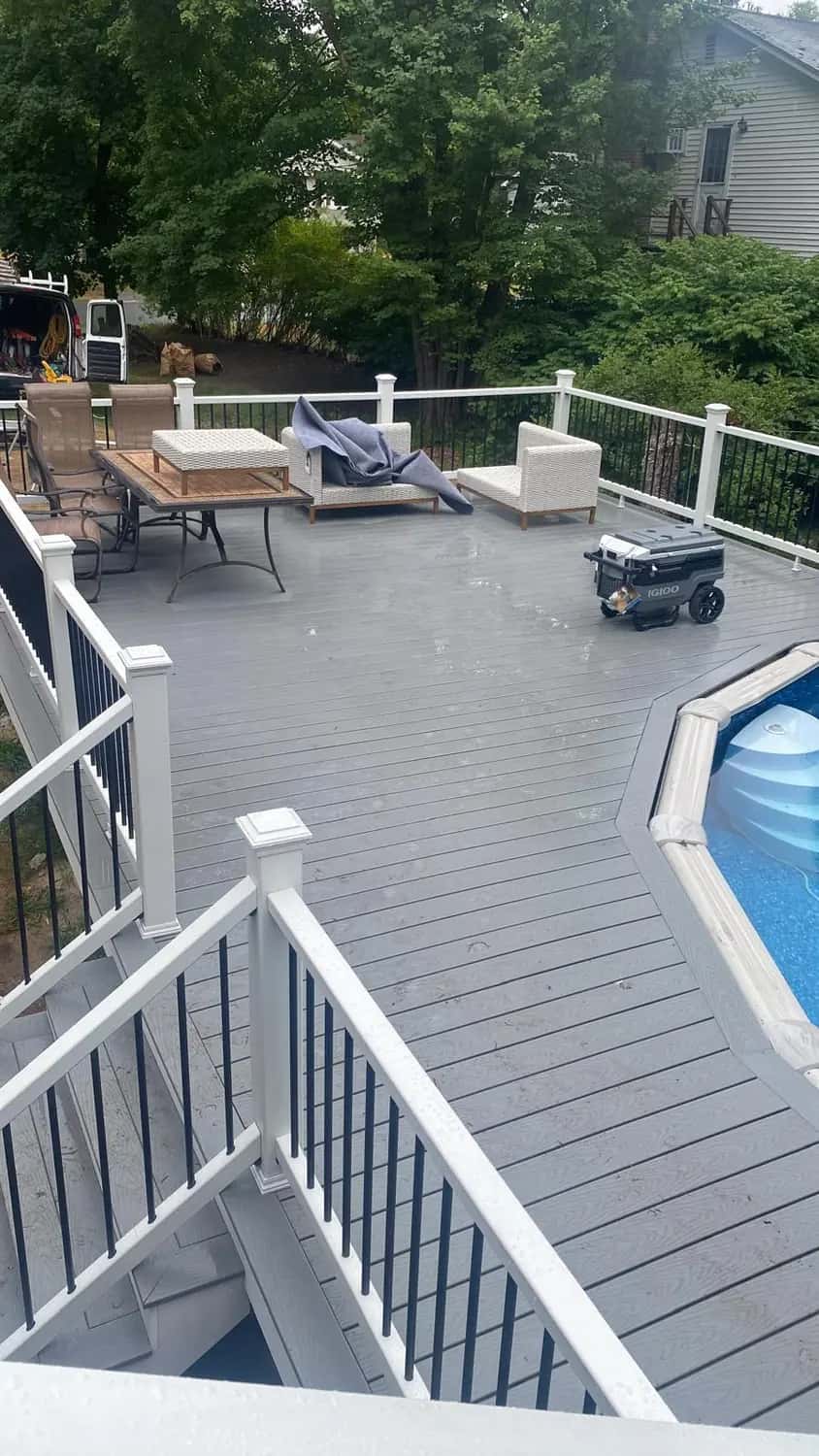
- Composite — does not rot, splinter or need sealing. It does get noticeably hot in direct summer sun, particularly the darker colours, and cheaper uncapped composite can fade and stain. Snow and ice are no problem, but use a plastic shovel.
- All of them — live or die on the frame underneath, which in Massachusetts is pressure-treated lumber regardless of what you walk on.
The part that is the same either way
Whatever you choose for the surface, the structure below is pressure-treated framing on footings that bear below the frost line. Frost depth is not optional in New England: a footing that stops short will heave over a winter or two, and once the frame has moved, the fix is rebuilding it.
This is why the same deck costs more here than in a warm state, and why the cheapest quote deserves a question about footing depth before anything else. See the full deck cost and planning guide.
You can change the decking in twenty years. You cannot change the footings without starting over.
How to choose, in one paragraph
Staying under ten years, or the budget is tight: pressure-treated, built properly, and commit to sealing it. Staying long term and you would rather not think about it again: composite. Somewhere in between, and the look matters more than the money: cedar. There is no wrong answer here — there is only the answer that matches how you will actually live with it.
And you will almost certainly need a permit
Massachusetts exempts a deck only if it is under 200 square feet, under 30 inches above grade at any point, not attached to the dwelling, and not serving a required exit door — all four at once. A deck off your back door fails the test on two counts regardless of material. We file the permit and book the inspections.
Where these figures come from
- Angi — Cost to Build a Deck in Boston, MA
- HomeGuide — Cost to Build a Deck
- 780 CMR §105 R105.2 — Work exempt from permit
Published market data for Massachusetts and Greater Boston, not Waterfront Construction pricing. Your own project is quoted from a site visit — get a free estimate.
Frequently asked questions
Is composite decking worth it in New England?+
For many homeowners, yes — composite resists rot, fading, and splinters and needs almost no upkeep, which pays off over our freeze-thaw seasons. Wood costs less up front but wants regular cleaning and sealing.
Does composite decking get too hot in the sun?+
Composite can feel warmer than wood in direct sun, especially darker colors. Lighter tones and shaded areas stay comfortable; it's rarely an issue for a pool or patio deck used in the evening.
How long does a wood deck last in Massachusetts?+
A well-built pressure-treated deck can last 15–20+ years with regular maintenance. Skipping cleaning and sealing shortens that; composite typically outlasts wood with far less upkeep.
Deck Design & Construction in Northborough & MetroWest, MA →
Custom decks and outdoor living spaces in composite or wood — the perfect extension of the home you already love.
See our decks services →Want this priced for your house?
The figures above are regional market estimates. The only number that means anything is the one measured at your address — and that costs you nothing.
- ✓ Free, no-obligation estimate — itemised, not a lump sum
- ✓ Licensed & insured · MA HIC #196540
- ✓ Owner-led — you talk to the builder, not a salesperson
- ✓ We reply within one business day
Get your free estimate
Tell us about your project.